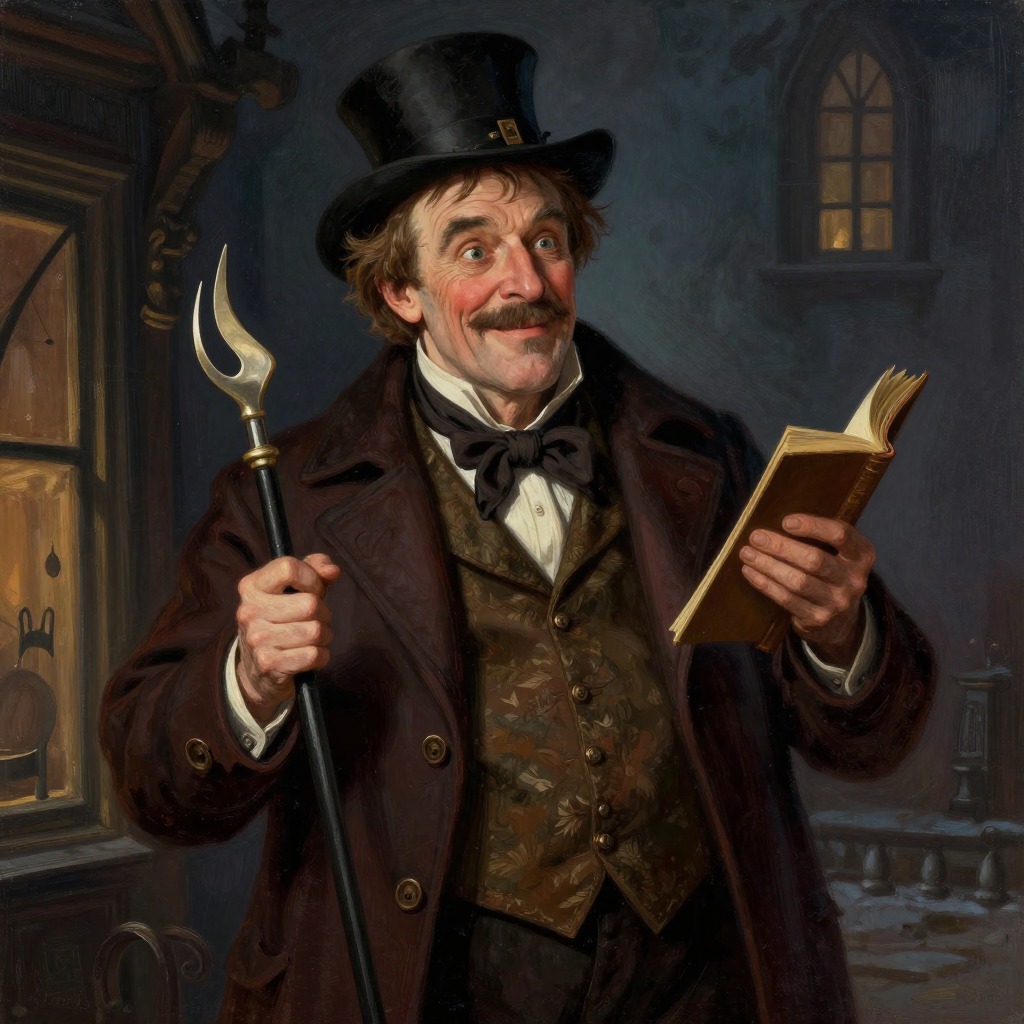
Christmas Eve
Christmas Eve is the temporal and symbolic heart of A Christmas Carol, the single night on which the entire drama of Ebenezer Scrooge's redemption unfolds. It is the day of the story's opening, the night of the three ghostly visitations, and the threshold between Scrooge's miserly past and his redeemed future. The narrative begins on Christmas Eve, with Scrooge sitting in his counting-house on a cold, bleak, biting, foggy afternoon, and ends on Christmas morning, when he awakens a changed man. The entire supernatural intervention—the visits of Marley's Ghost, the Ghost of Christmas Past, the Ghost of Christmas Present, and the Ghost of Christmas Yet to Come—is compressed into a single night, making Christmas Eve the crucible of Scrooge's moral transformation.
The Setting of the Story's Opening
The story opens on Christmas Eve, with Scrooge in his counting-house. The weather is described as "cold, bleak, biting weather: foggy withal" . The City clocks have just gone three, but it is already dark, and candles are flaring in the windows of neighboring offices. The fog is so dense that the houses opposite are mere phantoms. This atmospheric description establishes the oppressive, isolating mood of Scrooge's world. The counting-house itself is a place of coldness and parsimony: Scrooge has a very small fire, and his clerk Bob Cratchit's fire is so much smaller that it looks like one coal. Scrooge keeps the coal-box in his own room, preventing the clerk from replenishing his fire. The day is marked by Scrooge's characteristic miserliness and misanthropy. He refuses his nephew Fred's invitation to Christmas dinner, dismissing Christmas as "Humbug!" . He rebuffs two gentlemen collecting for charity, famously asking, "Are there no prisons?" and suggesting that the poor who would rather die "had better do it, and decrease the surplus population" . He grudgingly gives his clerk the day off on Christmas Day, but only after complaining that it is "a poor excuse for picking a man's pocket every twenty-fifth of December" . The day ends with Scrooge returning to his gloomy chambers, where he is visited by the ghost of his former partner, Jacob Marley.
The Night of the Supernatural Visitations
Christmas Eve is the night of the three ghostly visitations. After Marley's Ghost warns him of the coming of three Spirits, Scrooge is visited by the Ghost of Christmas Past, who shows him scenes from his own past, including his lonely childhood at school , his apprenticeship with the jovial Fezziwig , and the dissolution of his engagement to Belle . The Ghost of Christmas Present then shows him the present-day celebrations of others, including the Cratchit family's humble Christmas dinner and the festive gathering at his nephew Fred's house . Finally, the Ghost of Christmas Yet to Come shows him the bleak future that awaits him if he does not change, including his own neglected grave . The entire sequence of visions is compressed into a single night, making Christmas Eve a time of intense spiritual and emotional revelation.
The Threshold of Transformation
Christmas Eve is the threshold between Scrooge's old life and his new one. The story's structure emphasizes this transition: the narrative begins on Christmas Eve with Scrooge as a "tight-fisted hand at the grindstone" , and ends on Christmas morning with him as a transformed man, laughing and full of joy. The night of Christmas Eve is the time of his spiritual journey, during which he confronts his past, sees the present, and glimpses the future. The transformation is complete by Christmas morning, when he awakens to find that he has not missed Christmas Day. He immediately sets about making amends, sending the prize turkey to the Cratchits, raising Bob Cratchit's salary, and joining his nephew's family for Christmas dinner. Christmas Eve, therefore, is not just a setting but a narrative device that allows for the concentrated, transformative experience that is the heart of the story.
Thematic Significance
Christmas Eve in A Christmas Carol is more than a date on the calendar; it is a symbolic time of potential and change. The story's philosophy, as articulated by Scrooge's nephew Fred, is that Christmas is "a good time; a kind, forgiving, charitable, pleasant time; the only time I know of, in the long calendar of the year, when men and women seem by one consent to open their shut-up hearts freely" . Christmas Eve, as the eve of this day, is the moment of preparation and anticipation. It is the time when the barriers between the living and the dead, the past and the future, are thinnest, allowing for the supernatural intervention that leads to Scrooge's redemption. The story's power lies in its use of this single night to enact a complete moral transformation, making Christmas Eve the most important temporal setting in the narrative.